
Understanding Ross School Funding: Part 4 of 7
How do property tax changes affect school revenue?
Ross Local Schools has taken deliberate steps to make local dollars last longer.
Those steps include positioning the district at the 20-mill floor, developing a long-term facilities plan that schedules maintenance within our financial capacity, and taking a conservative approach to spending. Together, these measures help the district maintain its buildings, manage expenses, and plan beyond the current school year.
Recent changes to Ohio’s property tax laws alter the revenue rules behind that planning. They limit growth in school funding and restrict some options districts previously had for maintaining local support.
Property owners need relief from rising tax bills. Schools also need dependable funding. Ross believes state policy must address both needs together.
Why higher property values do not translate directly into more school revenue
An increase in a home or farm’s value does not mean the school district receives an equal percentage increase in revenue.
Ohio’s House Bill 920 generally reduces effective tax rates on many voted levies as existing property values rise. A levy designed to collect a certain amount does not simply collect proportionately more because those properties become more valuable.
Individual tax bills can still increase because properties change in value at different rates and different taxes follow different rules. A tax bill also supports several public entities, not just schools.
For school districts, one important exception to those rate reductions has been the 20-mill floor. That provision allowed certain operating revenue to grow with property values once a district reached the floor.
Ross’s financial planning included positioning the district to benefit from that provision. Recent legislation now limits that growth and changes how the floor is calculated.
What changed—and what does it mean for schools?
1. Limits on revenue growth at the 20-mill floor
A mill is a unit used to calculate property taxes. Historically, tax-rate reductions on qualifying school operating levies stopped when a district reached the 20-mill floor. At that point, increases in property values could produce additional operating revenue without a new levy.
House Bill 186 limits certain increases associated with the floor through an inflation-based tax credit. Eligible taxpayers receive relief, and schools receive less revenue than they otherwise would under the previous rules.
The law provides supplemental payments to qualifying districts in 2026 and 2027 to offset specified losses. Those payments do not establish a permanent replacement for all revenue affected by the changes.
House Bill 129 also adds certain fixed-sum levies to the floor calculation. Counting those levies toward the threshold can allow further reductions in other operating tax rates, limiting the growth districts previously expected.
For Ross, reaching the floor no longer provides the same opportunity for revenue growth that informed the district’s earlier planning.
2. Limits on growth from inside millage
Inside millage is property tax millage permitted without a public vote, within a legal limit shared by schools and other eligible local governments.
House Bill 335 caps growth in this revenue associated with reappraisals and valuation updates using a state-specified inflation measure.
This change affects schools and other local governments. It limits revenue that previously could grow with property values, but it does not place a corresponding limit on what districts must pay for insurance, transportation, utilities, staffing, or other expenses.
A legal limit on revenue growth does not limit the cost of operating schools.
3. Changes to emergency and substitute levy options
The state has also restricted the tools school districts could previously use to request additional operating revenue.
Emergency levies historically raised a specified dollar amount each year; their name did not require a district to be in a declared financial emergency. Substitute levies maintained an existing revenue amount while allowing additional growth associated with new construction. Importantly, neither levy option previously counted toward the millage calculation that determines the 20-mill floor.
House Bills 96 and 129 changed this. Traditional new emergency and substitute levies are no longer available to school districts. While limited renewal and fixed-sum levy options remain under specific circumstances, these levies now count toward the 20-mill floor calculation.
For districts such as Ross Local Schools, additional operating property tax millage could move the District off the 20-mill floor, limiting its ability to benefit from future increases in property values associated with county reappraisals and triennial updates. House Bill 186 has further restricted this potential revenue growth through the establishment of an inflation-based property tax credit.
The distinction matters: while school districts retain the ability to seek additional operating revenue, they no longer have the same flexibility or financial advantages associated with certain levy options.
The state has changed both how existing school revenue grows and which tools districts can use to seek additional support.
What does this mean for Ross?
Ross has worked to extend the life of its local resources through financial planning, facilities planning, and spending decisions. Those efforts remain important. They cannot, however, prevent the state from changing the revenue rules on which long-term plans depend.
The district’s facilities plan helps match maintenance and repairs to available resources. Conservative spending helps preserve those resources. Neither creates replacement revenue when state law limits what the district can collect.
There is also a tension between two parts of Ohio’s funding system. As explained in earlier installments, rising property values and income measures can cause the state formula to assign more responsibility to local resources. Meanwhile, property tax laws limit how much revenue those resources can generate.
Funding guarantees currently protect Ross from the lower amount the formula would otherwise provide. They do not resolve the underlying mismatch or automatically increase funding to meet rising expenses.
Several recent changes specifically target school funding mechanisms, including the millage floor and school levy options. These changes provide tax relief by limiting school revenue, but they do not establish a comprehensive, lasting solution to the balance between state support and local responsibility.
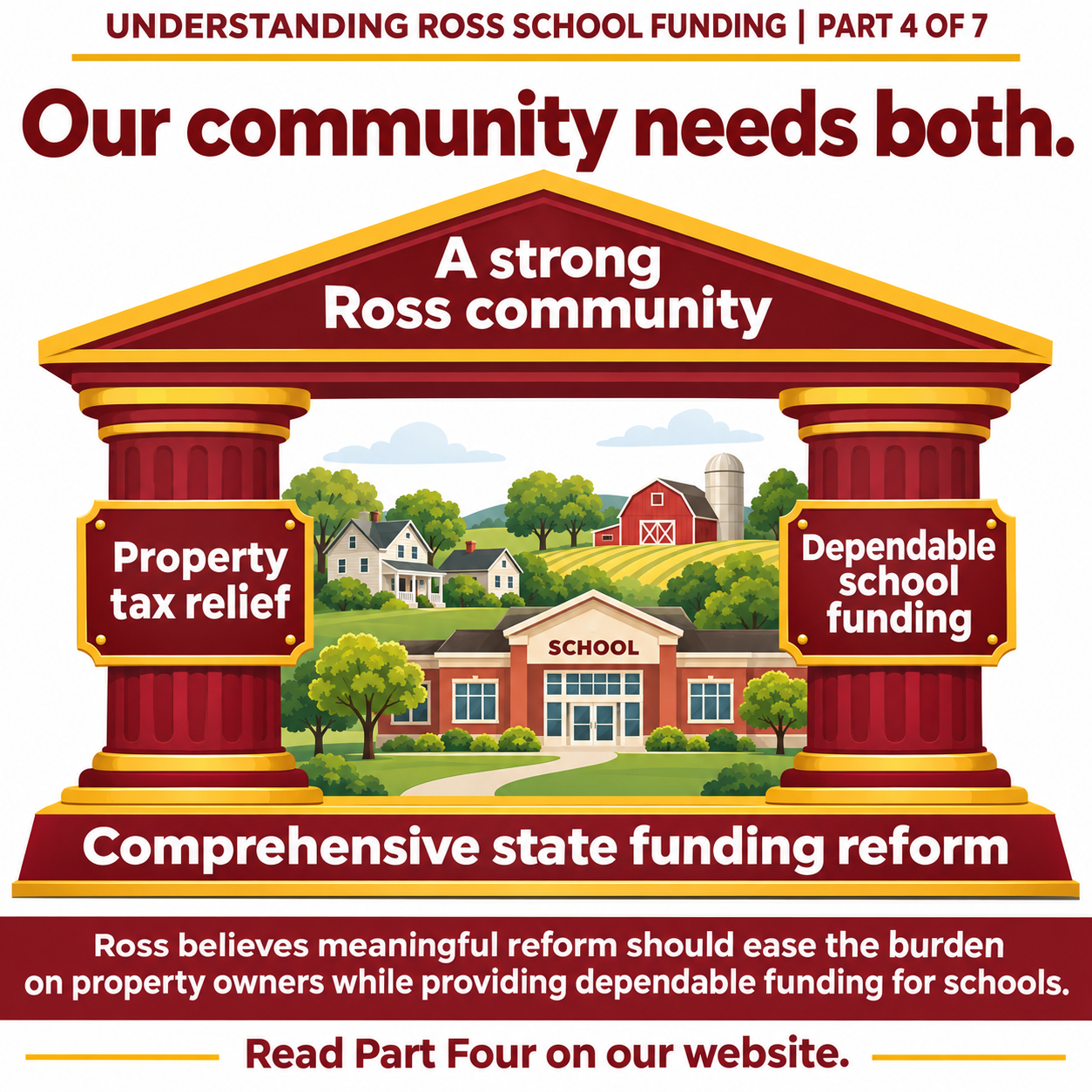
Ross believes meaningful reform should provide property tax relief alongside dependable school funding—including updated educational costs and a stronger state contribution—so residential and agricultural property owners are not repeatedly asked to make up the difference.
The work extends beyond school funding
Every change requires district leaders to determine what the law requires, when it takes effect, and how it affects Ross.
For financial legislation, that means reviewing revenue estimates, revising forecasts, evaluating levy options, and adjusting spending and facilities plans. It also means explaining why a projection made under one set of rules changes when the state adopts another.
The same implementation work occurs across instruction, student services, safety, staffing, technology, and reporting. New requirements can demand revised policies, legal review, staff training, and changes to daily procedures.
These responsibilities take administrative time and resources alongside the work of supporting students and staff. District leaders must carry them out while continuing to operate schools and plan for future needs.
Ross remains responsible for careful financial management. Our community also deserves to understand when state decisions change the resources available or add requirements the district must fulfill.
Ross has taken steps to make local funding last longer. Recent state decisions limit the revenue growth those plans relied on, requiring the district to revise its plans while continuing to meet students’ needs and comply with state requirements.
Stay informed
We encourage community members to attend the December 17 Board of Education meeting at 6 p.m. in the Ross High School media center. A recording will be available on the district’s YouTube channel the following day.
Coming next: What has Ross already changed to manage costs? Part Five will examine the district’s spending decisions and actions to preserve resources.